Today's questions is about the ed tech tools we use in my classes. Here's are the ones that are on my mind right now since we're in the midst of using them.
We use a range of Google apps in my class. We use and share Google Docs and Slides. Currently, my classes are learning how to use the "comment" function on Docs to facilitate peer revision. A third Google app we use is Blogger. This semester, students will publish between eight and twelve blog posts. This is my sixth semester using Blogger.
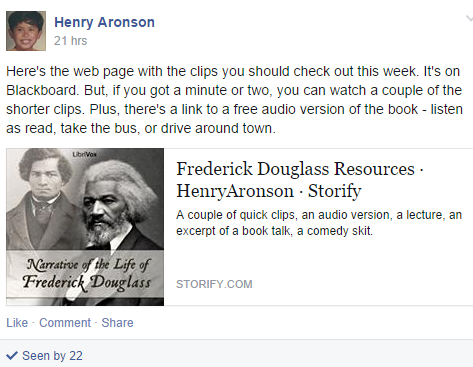
Another blogging tool we've used and will use again is Storify. Storify is an online tool that allows users to curate a variety of Internet sources: web pages, tweets, Tumblr and Facebook posts, and YouTube clips. The feature that makes Storify special is its ability to sequence the clips into a coherent narrative. Between each clip, you can include your own text to set up a "story". Your text stitches the together, providing transitions, explanations, and statements of significance to tie the different clips together.
I've used Storify to "flip" lesson, to curate tutorials. And I've assigned students to curate their own stories. Here's a post I curated to leverage the Donald Sterling story to teach a rhetorical concept. Here's another one about rhetoric.

To communicate with students, I use three different "channels". Our learning management system, Blackboard, has an email function that lets me contact students all at once, in groups, or individually. Blackboard is my purely academic/class-matters channel where I discuss assignments and content. It's also the channel I encourage students to contact me. Students can also communicate with each other through Blackboard without having to share their private email addresses.
We also use a secret Facebook group page. Because it's a "secret" Facebook page, students don't have to friend each other (or me). Our Facebook group page is the channel we use to share information about the campus and the larger community. Folks announce sports and campus events. Or they can post community events that are related to class content. Or web links and YouTube clips related to class. Students use our private Facebook page to encourage each other and to vent. Students can ask each other what's going on in class or for assistance. But if they ask me questions on the Facebook page, I'll direct them to use my email address.

This is my second semester experimenting with Twitter. We use Twitter as a "back channel", for folks to comment and curate what's happening in class. Students often take pictures of what I've written on the board or of each other working.
I use both social media channels to "push" content to students. I may share a "teaser" of an upcoming class or a video that we discussed in class. Or an article I found that relates to a class topic. Something short and sweet to whet the appetite and to extend our discussions beyond the classroom. Doing so encourages students to post content, too.
I am experimenting with more ed tech tools: Haiku Deck, Padlet, Professor Word, and others. Still on a learning curve with those programs - still trying to figure out if I'm being seduced with cool web tools or if these tools will enhance reading and writing instruction.