Monday, March 9, 2020

Taking Their Pulse: Five Weeks In, And Students Are Feeling . . .

One of the key takeaways I’m getting in a professional development program I'm attending is how the subject I’m teaching is more significant than English. 

The real subjects I’m teaching are the humans in the classroom. On a grammatical tip, students are agents, the ones doing the learning, not passive objects. They are people on a journey to resolve the problem of how to express ourselves in written academic discourse, the objective of our class.

So it’s on me to find out who the humans in my classroom are, what’s on their minds and in their hearts - just as it's on me to know the subject matter. A strategy I often use is focused free writes with stems, sentence starters that focus students on a particular topic or theme. 

At the five-week mark, I used sentence stems for a brief class warm-up. These "stretches" are part of an effort to ease students into the day's lesson, using writing and/or partner discussion, to help folks “enter” the classroom. On this day, I provided three sentence stems for students to share in partners or triads: 

Saturday, March 7, 2020

Students Curate and Share Examples of Freire's Modes of Education

As students in my composition courses prepare to write essays that take a position on Freire, we spent time collecting images, poems, and quotes. While students basically "get" Freire's ideas, I wanted to assess whether students could find illustrations on their own and if they could explain how those images exemplify Freire's ideas. In other words, do students know what I mean for them to know? 

Students have already read and analyzed a variety of poems and images that illustrate the Banking Concept and Problem Posing Modes of education. Those clips are included on the below Padlet, the ones labeled "Henry A."  For this particular assignment, a student looked for their own resources and had to explain in writing how those resources illustrate Freire's ideas.  

This Padlet task supports the "big essay" assignment on Freire's ideas. Students have two options for the  prompt: "The kind of education I deserve" and "The education that Southwestern College students require to solve our community's problems." Freire's two modes of education serve as our "theoretical framework" to help students articulate their answers, answers they've already been addressing for a few weeks previously (see previous entry titled "Writing as a Pre-Reading Strategy").

Thursday, February 20, 2020

Writing as a Pre-Reading Strategy: Thinking like an Education Philosopher

-Dehumanization and schooling is the theme of the first writing project in two of my English Composition courses this semester. 

We will read chapter two from Paulo Freire’s Pedagogy of the Oppressed, where he outlines the “banking concept” and “problem-posing” modes of education. Instead of diving directly into his prose, I wanted to see how students were already engaged with Freire’s ideas, even without having read his text. 

To do this, we examined several editorial cartoons that depict the banking mode of education and a couple others that point to the possibility of another mode of education.

After discussing what we observed and interpreted, students had the opportunity to talk in pairs about what they experienced in school. How representative were the cartoons of their own experience or observation? 

Saturday, February 15, 2020

Using Mentor Texts to Reckon with Nuanced Reactions: Aly Wane's "A (Complicated) Prayer for Kobe"

Aly Wane, Human Rights Worker in Syracuse, New York 
To acquaint students with using the texts they read as mentors for their writing, I chose as our first topic, Kobe Bryant. I wanted to pick a timely topic that would help students work through their complicated reactions to Kobe's death.  I selected what was initially widely disseminated on a Facebook post by Aly Wane, a peace activist living in Syracuse, New York. Published under the title of “A (Complicated) Prayer for Kobe.” Wane’s piece has subsequently been published in the online magazine America: Jesuit Review

Wane’s poem enacts a dialogue going back and forth between the narrator’s contradictory feelings about Kobe Bryant and the moment of national mourning. Was Kobe a hero? A villain? To whom? And why? The poem doesn’t definitely land on one side or the other. Instead, Wane asks us to recognize our own messy, imperfect human lives that can’t be reduced to a single moment or action. As Wane points out, “I will hurt and harm the people I love."  

Saturday, February 1, 2020

Attending to Affective Domain with Word Clouds

This Wordle captures students' responses on the first day of class.
This semester, I want to do my best to weave in social-emotional learning and affective domain into lessons or activities that engage critical thinking and writing skills. 
We began our first week of school this past Wednesday. I wanted students to reflect on their initial thoughts and ideas about being back in school after a six-week break. So during our first meeting, I asked the class of just under thirty college students to jot down three single words that describe their thoughts and feelings about being in an English class. Then at the end of our second meeting, I asked them about what they were thinking and feeling now that we've met twice. The Wordle above captures the "before" responses, the one below, the "after." The fonts size represents the number of responses. 

Sunday, December 2, 2018

Using On-Line Bulletin Boards to Help with Reading

An important skill scholars are supposed to practice in composition is to find meaningful quotes and passages from the texts we read. We expect writers to support their ideas with outside sources. For sure, scholars’ opinions can be rooted in personal observation and experiences. But that isn’t enough; writers need to buttress their positions by quoting other thinkers, “recruiting” other writers’ words and ideas to support their own. 

In addition to finding quotes, developing writers need practice paraphrasing those ideas, rewording those quotes to illustrate how those sources fit into their own arguments. 

To practice finding and paraphrasing quotes, I’ve been experimenting with the bulletin board application Padlet to record and share the intellectual labor students accomplish. My goal was to make the process less solitary and to help the entire class profit from each others’ work. 

After we read and initially discussed chapter two of  Paulo Freire’s Pedagogy of the Oppressed, I divided the class into groups. Each group tackled one of five topics we’d noted during those discussions: banking mode, problem posing, oppression/conformity, freedom/liberation, relevance/real life. I asked students to locate where Freire defined, clarified, or elaborated on those themes, urging them to look for quotes that they thought were especially meaningful or relevant.

Thursday, October 5, 2017

Poetry & Pedagogy: Prepping for an In-Class Essay

To prepare students for an upcoming in-class essay, we did a version of “reciprocal teaching.” The essay prompt asks students to use two scholar’s theories to make sense of a phenomenon. In this case, the theorists are Paulo Freire and Jean Anyon, two educational scholars. The object of study is a classroom of their choice - perhaps one they remember from elementary or high school or one they are currently enrolled in here at college.  We’d done multiple “draft readings” and several pre-writing activities to unpack the scholar's ideas, but the “moment of truth” was upon us, and I wanted to them to rehearse. 

Sunday, October 1, 2017

Brain Dumps, Summaries, and Collaborative Writing

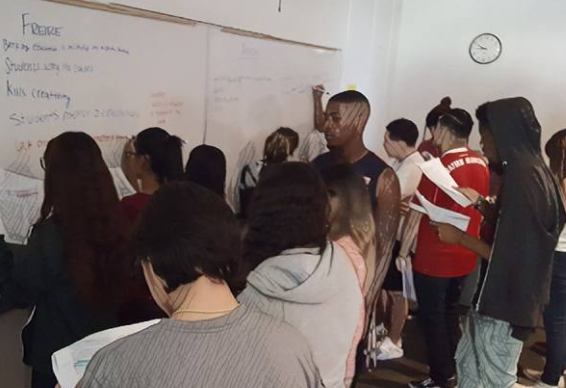
Today in two of my classes, we did a brain dump, where both class went the whiteboard and “dumped” everything they had in their brains about two of the major readings we’ve been analyzing. By “dump" I mean list absolutely everything they knew about our two readings. Half the class worked on Paulo Freire chapter “The ‘Banking Mode’ of Education”. The other focused on Jean Anyon’s “Social Class and the Hidden Curriculum.” We’re working on a big writing project based on both readings, and I wanted to do some retrieval practice and to compose summaries - a key element of their essay.

Thursday, September 28, 2017

Spotlighting Student Voices Using the Author's Chair

I finally attempted the “author’s chair” activity, something I had experienced at San Diego Area Writing Project. This protocol calls for students to take a seat in the front of the room to read a piece of their writing, typically a work in progress. I never had the nerve to try before. What if no one volunteered? What if students didn’t respond? What if students weren't interested in each others' ideas?

On this particular day, students had completed a mini-essay, a flash draft. I set up the room, explaining the process. I reminded folks about one of our “class agreements”: No apologies! What we write in class are first drafts, sloppy and scribbly, so there’s no need to say “I’m sorry".  I want students to be be okay with the natural imperfections of an early draft. I want them to develop the nerve they need to share works in progress. 

Monday, September 25, 2017

Previewing & Pre-Writing: First Year Students Dive into Freire

I’m rediscovering how important it is to provide students with multiple “ways into a topic” when approaching a new text. I admit that I used to simply assign a reading and then be upset with myself and students for not understanding the text. 

Starting last year, I took intentional steps to to solve the problem of preparing students to read. My particular challenge this semester? To access prior knowledge and to provide background knowledge before plonking them into chapter two of Paulo Freire’s Pedagogy of the Oppressed.  

Wednesday, September 20, 2017

Feeling the Burn of Mentor Texts & Mea Culpas

Teachers should learn from students. This statement has become so axiomatic as to become cliche. Tired, even. And yet, it’s a home truth, one that I subscribe to because of my study of Paulo Freire and bell hooks On an intellectual, theoretical tip, I get it. Teacher-student. Student-teacher. Resolve the contradiction between those roles. 

A recent pair of episodes, however, hit me at an experiential, gut level. What happened in class taught me, in a new way, essential lessons. Students modeled how I can “practice what I preach in terms of the kind of person I want to be and the kind of writer I aspire to become. 

Saturday, September 16, 2017

Debriefing DACA in the Writing Class

When given a chance, students testify to their desire for meaningful lessons. As one student wrote in an exit ticket, “Teachers can help us learn . . . about real life.” In an online discussion, students agreed they want to know how to deal with issues they encounter in their lives. They want relevant lessons that apply to their lived realities. That and the fact that our campus is located in Chula Vista, a stone's throw from the border, compelled me to discuss the repeal of the Deferred Action for Childhood Arrival (DACA). As a college professor, I have a duty to address an issue that affects so many in our community. I am also obligated to show students how a critical thinkers might approach these kind of issues.

Monday, April 17, 2017

Experiments with Digital Annotation

I wanted to help students comprehend assigned readings. So I felt excited to give Hypothes.is, an online shared annotating/note taking program, a try. I’m still getting acquainted with the program and all its functions. But I can already attest to the value of digital annotating. Students can highlight as they would on actual paper, and they can jot down notes, or add links and images. Since everyone in class can see and comment upon everyone else's digital notes, students can start discussion threads anchored to readings.

The big goal here isn't to learn to highlight for the sake of highlighting nor to use digital tools out of a commitment to technology. Instead, I wanted to provide students a way to engage in meaningful reading and dialogue to develop content for their essays.

So I uploaded readings them onto Hypothes.is, “seeding” them with highlighted notes about content and structure. I introduced the texts to students. And I demonstrated Hypothes.is in class, devoting laboratory time for students to sign up and practice.

Tuesday, April 11, 2017

"Chopping Up" Pinoy Psychology: AXES Illustration Paragraphs


The above clip features psychology Professor Kevin Nadal (he also does stand-up - talk about renaissance man). I like how Nadal illustrates Filipino American psychological phenomena using humor. I use his text book Filipino American Psychology in a composition class I teach. Why? For one, the class is part of a Filipino American Learning Community, so the subject matter is right on time. Secondly, the book features rhetorical modes typically found in college textbooks. And one of the big lessons I hope to teach is how to recognize and replicate those types of writing.

Sunday, April 9, 2017

P.O.W.E.R. & Thriving: Formulas for Success

We’ve been studying various ways to explain growth - leaning on traditional models of student development like Perry and Kohlberg. We also examined racial identity development models (see beverly Daniel Tatum's "Talking About Race, Learning about Racism"), another crucial area of growth. Movement through developmental models (ethical, moral, racial) can lead to an overall state of flourishing. 

One formula that measures how students flourish is what education professor Laura Schreiner calls the “thriving quotient.” Her formula accounts for the kind of growth we’d like students (and ourselves, as life-long learners!) to achieve. Schreiner breaks up her formula into five common sense factors: Social Connectedness, Positive Perspectives, Academic Determination, Valuing of Diverse Citizenry, and Engaged Learning.

She describes those ingredients in her essay, "The Thriving Quotient.” Social Connections speaks to fostering social capital and “soft skills” we need for collaborative work. Positive Perspective refers to positive psychology theories like Carol Dweck’s “Growth Mindset” and Angela Duckworth’s “Grit.” Academic Determination has to do goals, attitudes, and skills for growth. Value for Diverse Citizenry isn’t only about the ability to work well with different kinds of people. It’s about hope and the spirit of optimism that intergroup collaboration makes a difference. Engaged Learning accounts for actively participating in one’s learning.

Wednesday, February 22, 2017

Podcasts & Classroom Conversations

As is my habit, as I drove home from work, I was listening to a podcast, Slate’s Audio Book Club. Because we are in the middle of studying Ta-Nehisi Coate’s recent book Between the World and Me, I wanted to supplement my reading with the opinions of Slate journalists that I respect: Jamelle Bouie, chief political correspondent, Katy Waldman, a staff writer, and Meghan O'Rourke who writes about culture, and she has recently published a memoir about her mother’s death Their podcast conversation was smart. Erudite. Insightful. The journalists manifested a breadth and depth of knowledge that added so much to my reading of Coates’ epistolary memoir. 

Listening to them reminded me of being in graduate school seminar, where we tested our ideas, took (and changed!) tentative positions about an author’s content, and sought to find the significance of the texts before us. 

Wednesday, December 7, 2016

End of Semester: Minor Victories!

Finals start today. And I’m feeling, well, pretty good. Usually this time of year, I’m out of sorts. And that’s putting it mildly. It’s the season of recriminations and regrets: “I didn’t finish everything I had planned! Students won’t be ready for their next English class. How did I fall so far behind? Someone’s gonna figure out I’m a fake.” The chorus in my head should be working overtime. 

But it’s not. I’m almost feeling . . . optimistic, uncharacteristically calm.  Is this denial? Have I drunk so much coffee and eaten so much junk food (stress eater!) that I’ve numbed myself out so completely, immunized against my inner critic? 

For certain, there are kernels of truth in my Greek chorus’ remorseful refrain. I could have more effectively prepared student. I could have used my time more wisely. And I’m definitely a master of “acting as if.” But for some reason, my self-recriminations aren’t piercing my so deeply. 

Tuesday, September 27, 2016

Courageous Conversations at Southwestern College

My colleagues and I organized a Courageous Conversations dialogue program recently for all three of the multicultural learning communities here on our campus: Bayan, the Filipina/o American focused learning community; Puente, the Latina/o learning community: and Umoja, the learning community focused on African and African American students and issues. 

We, along with the professional development office  on our campus, wanted to create a space for dialogue about human relations issues that our students face - race, gender, criminal justice issues, internalized racism, colorism, and class to name a few. And we wanted to broaden the circle of safety that naturally develops in a learning community to a wider circle.

We used as our inspiration the book Courageous Conversations About Race by Glen Singleton and Curtis Wallace and a version of a discussion protocol called “conver-stations” from the Cult of Pedagogy website. In addition, I was inspired by a workshop I attended in Spring presented by the San Diego Area Writing Project, revising their program for a student audience. I'm grateful to all our sources for their intellectual generosity! 

Participants at the SDAWP workshop ( K- 16 teachers, professors, and administrators) rotated through three rounds of conversations ranging from sexual orientation and diversity to social justice activism to institutional racism. Each conversation took place at a table with about ten (10) people and a facilitator. After the workshop leader welcomed participants and reviewed communication agreements, facilitators at each table asked participants to introduce themselves and to briefly (ever so briefly!) state their investment in the issues. Then, each facilitator took a brief moment to either share short readings or share a set of provocative questions to get the conversation going. 

Sunday, September 18, 2016

Using Music to Distinguish Between "Content" and "Structure"

A major objective in all my classes is for students to distinguish between content and structure, between the meaning of a text and the strategies authors use to construct that meaning. Students typically come into my class with strong summary skills, and they are definitely on the path toward being able to identify an author's main and secondary ideas, i.e., the content. Certainly, they can strengthen those skills - and that’s why they're in my class! 

The more difficult skill to master for practically everyone in my classes is to identify the moves or structures that the authors use to express those ideas. By “moves” and “structures,” I mean what the writer does to express her content: describe, explain, contrast, express effect, tell a story, use dialogue, state a point, or give examples.

Certainly, “meaning” and “moves” are mutually reinforcing, difficult to separate. At the same time, I want students to be able to identify what writers do so they can emulate those moves to express their own ideas. To introduce students to this process, we examined texts students are already deeply invested in: music they love.

Monday, September 12, 2016

Using Comments to Foster Community & Communication

One of the biggest problems I have when teaching peer revision is getting students to comment on each others’ drafts. Student often lack confident enough in their own opinions and reactions, so they believe they have nothing of value to say when giving feedback. So while I’ll never completely prevent their reticence to commenting, I chose to do some work that might warm students up to the task. 

For homework, I asked students to reflect on their time in college. Since most (with the exception of two or three) of the students in my classes are entering freshman, I’ve been assigning reflective writing assignments over the weekend. This particular assignment was the “4S” reflection. Students wrote about what Surprised them about their first weeks in college, what Sacrifices they are making to be in college, what Solutions they are having to come up with for the problems they are encountering, and what they think or feek about becoming a Scholar. Low stakes writing. But meaty enough questions relevant for students transitioning into college.